Pages

Showing posts with label Local History. Show all posts

Friday, May 27, 2011

The Chautauqua County Silk Industry

Here's something interesting from the history books: for about 30 years, Chautauqua County had a flourishing silk industry. Apparently silk production in Chautauqua County began in the late 1820s by a man who is more famous for his role in grape production. Within ten years a "cocoonery" was in operation along the Chadakoin River in Dexterville (East Jamestown). A detailed history of the Chautauqua County silk industry can be found in a book entitled "The Conquest of Chautauqua" (1932) by Arthur Wellington Anderson - County Historian.
The raising of silk worms, and the reeling of silk was introduced in this county by Elijah Fay, of Brockton, in 1827, when he brought from the East the mulberry trees, prepared for the production of silk. The industry spread slowly at first, but rapidly over the county in the 30's and 40's. About the year 1845, it began to decline, and was probably nearly extinct by 1860.
- Chapter XII: Highlights in County History -The Silk Industry in Chautauqua County (p. 357)

Sunday, April 10, 2011

Autobiography by Samuel A. Carlson - Meeting Adolf Hitler

Samuel A. Carlson, circa 1900
Continuing with the post from Feb. 26, 2011 regarding the 1943 Autobiography of former Mayor of Jamestown, Samuel A. Carlson (1868–1961).

I thought I'd jump ahead in the book a little bit and present the passage in Carlson's Autobiography where he discusses his encounter with Adolf Hitler. The meeting took place during the summer of 1933 when Carlson - along with a group of other U.S. mayors - toured nearly every major country in Europe. The purpose of the trip was to promote municipally owned/operated utilities and services. 

Carlson first mentions his meeting with Hitler on page 46 of his autobiography. The section is entitled, "Hitler True to Form." I think it was most likely written in 1942 or early 1943. The mayor is, as expected, highly critical of the German leader.  

Tuesday, March 29, 2011

Old Jamestown - Alonzo Kent

While doing research, I came across a series of articles that appeared in the Jamestown Evening Post from November 1919 through February 1920. The were simply entitled "Old Jamestown" or "Old Jamestowners" and dealt with the early history of the city.

This specific article involved Alonzo Kent, came to Jamestown at the age of 22 with a mere 50 cents in his pocket. But in due time, Kent became a very prosperous businessman, owning the Kent House Hotel in Lakewood and the Kent Mansion in Jamestown, which was the first brick home built in the city. No expense was spared when this Italianate mansion was constructed. Today, the Kent Mansion serves as the home of the Robert H. Jackson Center.

Friday, March 25, 2011

Old Jamestown – Chautauqua Lake Dredging

While doing research, I came across a series of articles that appeared in the Jamestown Evening Post from November 1919 through February 1920. The were simply entitled "Old Jamestown" or "Old Jamestowners" and dealt with the early history of the city.

The following deals with the first dam on the Chadakoin, built sometime in the 18th century by French soldiers, prior to the Revolutionary War.

Monday, March 7, 2011

Old Jamestown – The Blind Horse Dance

While doing research, I came across a series of articles that appeared in the Jamestown Evening Post from November 1919 through February, 1920. The were simply entitled "Old Jamestown" or "Old Jamestowners" and dealt with the early history of the city.

The following article deals with the first dance in Jamestown back in 1816. It would be referred to for years afterward as "The Blind Horse Dance."

Old Jamestown
(Jamestown Evening Post – Jan. 7, 1920)
The Allen Tavern - Built in 1815 at the Southwest Corner of Main and Third Streets, burned in 1852. It's not known if this is the structure that hosted the "Blind Horse Dance," but it was built during the same time period.

Sunday, March 6, 2011

In Memoriam: William Broadhead - Part 2

Last month I posted some information about William Broadhead, one of the most well-known manufacturers in Jamestown's history. The text came from a booklet various newspaper articles detailing the life of Broadhead. It was published shortly after his death. 

Here is another article about Broadhead, this time published two days after his death in the
Jamestown Morning Post. That day's editorial from the Post can be found below the article.

Sunday, February 27, 2011

Chautauqua County's First Bar Room Brawl

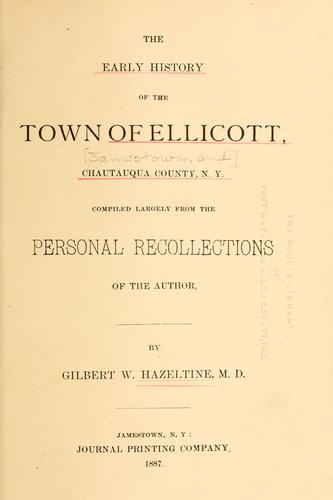
Recently, I've been reading "The early history of the town of Ellicott, Chautauqua County, N.Y." by Dr. Gilbert Wilkinson Hazeltine (1816-1893). Printed in 1887, this book gives an outline of the early history Chautauqua County as it pertains to Jamestown and surrounding area. The town of Ellicott was set off from the town of Pomfret in 1812. It initially comprised not only the present area of Ellicott, but also the present-day towns of Poland, Kiantone, Carrol and Busti, along with the current city of Jamestown.

In addition to offering some lively and colorful stories regarding the early settlement and development of the southeastern area of the county, Hazeltine also provides some details about the establishment of the county government, including one of the first court cases heard in county court back in the summer of 1811.

The story involves what could be the first bar room brawl ever to take place in Chautauqua County. It  happened in Mayville with no fewer than 16 men, several of whom were scarred for life. One guy had his thumb bitten off and the plaintiff in the subsequent court case was scalped and laid up for two months afterward. The two factions were the area's early pioneers vs. a contingent of keelboatmen who were transporting supplies. It was the culmination of a series of prior altercations, including one incident where Capt. James Dunn, Portland's first settler, had his eye gouged out by a keelboatman by the name of "Valentine."

Saturday, February 26, 2011

Autobiography by Samuel A. Carlson - Part 3

Continuing with the post from Nov. 8, 2010 regarding the 1943 Autobiography of former Mayor of Jamestown, Samuel A. Carlson (1868–1961).

Much of this passage deals with the establishment and improvement to Jamestown's water system. In addition there is mention to Carlson's efforts to establish a Natural Gas Plant and a Telephone Plant. I think one of the most interesting parts of this section, however, is Carlson's feelings on partisan elections, and his endorsement for the removal of party affiliation on the ballots. This portion of the section can be located at the end under the sub-heading, "Non-Partisan Election."

Samuel A. Carlson, Circa 1900
Autobiography by Samuel A. Carlson - Mayor Emeritus
and Comments on His Fifty Years of Public Service
[Page 9 - 12]

In Memoriam: William Broadhead - Part 1

I was doing some research for the Bicentennial Biographies project and came across a booklet detailing the life of William Broadhead. Broadhead was born in England in 1819 and moved to Jamestown, N.Y. when he reached adulthood. In his life, he became the city's leading industrialist - employing thousands of residents at the Broadhead Mills operation on First St. in Jamestown and later the Jamestown Worsted Mills operation on Harrison St. He died in May, 1910 and it may have been one of the few times in the city's history that nearly all operations came to a halt to pay tribute to one individual.

Wednesday, January 5, 2011

Radio Project to Feature 200 Notable Individuals from Chautauqua County

Below is the Media Release I wrote for the Bicentennial Biographies project, set to begin Jan. 10 on eight different radio stations in Chautauqua County, - SE-93, WJTN, WRFA, WQFX, WKSN, WHUG, WBKX and WDOE. 

I'm excited to that it will soon be hitting the airwaves and I encourage you to tune in and check them out. From what I understand, WDOE will air them during the morning show while WJTN will air them during the noon news hour at 12:25 p.m. and SE-93 will air them at 12:05 p.m.

For a sneak preview of one of the PSAs, CLICK HERE.


'Bicentennial Biographies' PSA Project begins Jan. 10 and continues throughout 2011

 Chautauqua County will celebrate a major milestone throughout 2011 with its 200th birthday. To celebrate the bicentennial, historical groups and societies all over the county will be involved in a variety of events and promotions throughout the year.

One promotion that will be ongoing throughout the entire year is “Bicentennial Biographies,” a public education project that will feature 200 notable individuals from the county’s past. Each weekday a different biography will be broadcast as a Public Service Announcement (PSA) on participating local radio stations, giving details about the individual, some of whom have not only left an indelible mark on Chautauqua County History, but also national and world history.

In an effort to create the most comprehensive and thought-out list possible, organizers teamed up with local historians to determine the 200 people to be featured. The biographies will not only include those born in Chautauqua County, but also those who moved elsewhere to make their mark in the world as well as the adopted sons and daughters who were from outside of the county but eventually found their way here and, as a result, helped to shape a particular community or even the entire county.

Saturday, December 18, 2010

Chautauqua or "the Place of Easy Death"

While doing research for the Bicentennial Biographies project,  I was reading Andrew Young's "History of Chautauqua County, New York" (1875). The opening chapter, which was written by historian Obed Edison, tells of Chautauqua County's history prior to settlement by the white man. The entire section is fascinating, but I was especially intrigued by telling of the origin of "Chautauqua" - so intrigued that I figured I'd share it on my blog. Enjoy.

Vintage Map of "Chautauque" County
The name Ohio, or La Belle Riviere, was applied by the French to that portion of the Allegany, extending up from Pittsburgh as far, at least, as Franklin, as well as to the Ohio proper. It is probable that the Connewango, Chautauqua lake and outlet, and perhaps that part of the Allegany below the mouth of the Connewango to Franklin, were called by the French the Tchadakoin, as inscribed upon this leaden plate [see 'Lead Plate Expedition' in this link], and that, in process of time, this appellation was retained only by the lake. The word underwent various changes in its orthography also, until it came to be spelled "Chautauqua."

Sunday, December 5, 2010

Bicentennial Biographies Update

I've been busy the past few weeks with a project out in Delaware Co. NY but I thought I'd take a little bit of time this Sunday to offer an update on Chautauqua County's Bicentennial Biographies project.  Basically, we are going to feature a brief biography of 200 noted individuals from throughout the county's 200-year history. The biographies will first be broadcast as PSAs on local radio, then published online for anyone wishing to view and comment. All biographies are being assembled by myself, County Historian Michelle Henry, and various town historians from throughout the area. We are making good progress and are confident the first biography will air on January 10, 2011.

Monday, November 8, 2010

Autobiography by Samuel A. Carlson - Part 2

Continuing with the post from Oct. 31 regarding the 1943 Autobiography of former Mayor of Jamestown, Samuel A. Carlson (1868–1961).

Here, Mayor Carlson discusses the first time he was elected mayor of the city and his unwillingness to toe the party line. He also talks about the city's purchase of the local Niagara Power System, under his administration, which led to an enormous savings to the city while also providing affordable electricity to every resident in Jamestown.

Samuel A. Carlson, Circa 1900
  Autobiography by Samuel A. Carlson - Mayor Emeritus
and Comments on His Fifty Years of Public Service
[Page 5 - 9]

Sunday, October 31, 2010

Autobiography by Samuel A. Carlson - Part 1

Last week I was visiting a few local antique shops and came across a signed copy of the Autobiography of former Jamestown Mayor Samuel A. Carlson (1868–1961). Carlson was the longest-serving mayor in Jamestown's history and he compiled an impressive 50 years of public service to the city. As a result of his various municipal projects,including the effort to provide affordable electricity to the residents and businesses within the city, he's considered one of the most prominent and influential people in Chautauqua County's history and is one of the 200 people who will be featured in next year's Bicentennial Biographies project. 

To celebrate his milestone of 50 years in public service, and at the urging of various friends and colleagues, Carlson wrote and published his autobiography in 1943, printed by the Liberty Printing Company of Jamestown, N.Y.

Since several people have told me they'd be interested in reading the book, I thought it may be best to offer as much of the biography as time would allow on my blog. So from time to time I'll enter passages of the book. Also, anyone interested in borrowing the book and reading it can do so by contacting me. It's only 72 pages long, making for a fairly quick read.

Samuel A. Carlson, Circa 1900
Autobiography by Samuel A. Carlson - Mayor Emeritus
and Comments on His Fifty Years of Public Service
[Page 1 - 4]
 

Friday, October 8, 2010

The Great Wolf Hunt in Chautauqua County

I recently became a member of the Chautauqua County Historical Society. One of the perks of the membership (in addition to free admission to the McClurg Museum in Westfield) is receiving the quarterly newsletter, TimeLines. The current issues has a small article regarding the wolf hunts that took place in Chautauqua County during the pioneer days. Coincidentally, I also wrote a brief article about the Wolf Hunt of Chautauqua County as described in History of Chautauqua County by Andrew Young (1875). I never got around to publishing the article until now.


Journey through the woods and forests of Chautauqua County today, and its highly unlikely you’ll encounter a wolf. But this wasn’t always the case. While some speculate that "wolves" encountered during the pioneer era were more often than not coyotes, it can't be denied that wolves were native to our area of the country and posed a significant threat to not only livestock, but people as well. This is why no one - man, woman or child - ventured from their houses at night without a torch or weapon for their protection.

When it comes to the menace of wolves in Chautauqua County, it’s believed no town suffered more than Stockton. Judge Bugbee (Judge was his first name, not his title or occupation), who would serve as town supervisor in the 1850s and whose family was one of the first settlers in the Stockton area, wrote an extensive description of one of the several “great wolf hunts” that took place in Stockton during the 1820s in an attempt to rid the forest of the beast once and for all.

Monday, September 20, 2010

Brick is Red

Courtesy of S. Holland (via Retro Jamestown on Facebook)
Brick streets. Let's talk about 'em.

The well weathered brick streets of Jamestown can be found in just about every neighborhood throughout the city. While many of the streets have held up well, there are quite a few that have become the bane of several local residents' existence (especially anyone who's ever lived on Linwood).

Last Fall (October, 2009), the city unveiled a historical marker on Allen St. devoted to the brick streets of Jamestown. It was placed at the Allen St. location because that's where all the bricks came from. Typically, some details about all Jamestown's historical markers in the city can be found here at the city's website. Unfortunately, they've yet to post details about the newest historical marker. So here are some details from a story I wrote for the Chautauqua Star (Many of the details for this article were provided by Jamestown City Historian, B. Deloris Thompson).

Tuesday, September 14, 2010

Chautauqua County History

I'm currently helping the Chautauqua County Historical Society with a project to help promote the county's upcoming bicentennial (Chautauqua County was incorporated in February, 1811). It's called "Bicentennial Biographies" and will feature the 200 most notable people from Chautauqua County over the past 200 years. Once our list is completed, the Bicentennial Biographies will be produced into one-minute radio PSAs, with a new one airing each day on radio stations throughout the county. They will also be available online on and possibly in the local newspapers.